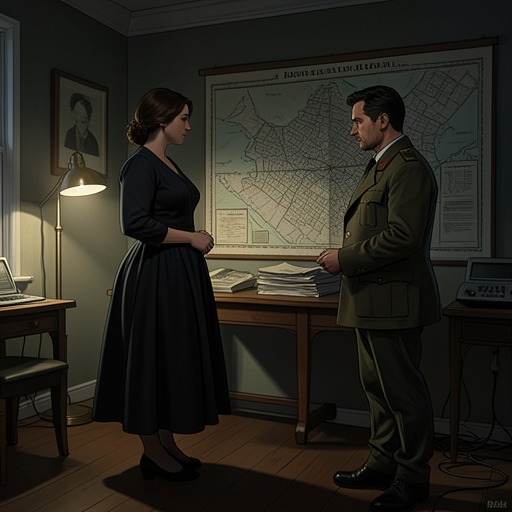
“Just a game”
The Peripheral“Just a game” is Flynne Fisher’s repeated effort to draw a boundary between simulated violence and consequential reality. Its meaning changes as she confronts what she has seen: a brief reassurance becomes an expression of grief, disgust, and refusal, before she uses the same words to explain herself to Burton Fisher. The phrase does not settle the question; its repetition exposes how little comfort the distinction can offer.
First Use as Reassurance
Flynne first says “Just a game” to herself more than to the person beside her. The wording makes the phrase sound like a practical reminder, but its inward direction suggests that she needs to persuade herself. In the same exchange, another speaker praises her as the best person available to someone occupied with lawyering, and she reflects on the possibility that he might as well have been getting himself a Marine. The phrase therefore appears amid judgments about competence and danger, not as an abstract comment on entertainment. Its first function is to keep an unsettling experience at a manageable distance.
That boundary proves fragile. Flynne thinks she sees the haptics produce a shiver, but the sensation is gone almost as soon as it appears. The fleeting bodily signal sits uneasily beside her verbal insistence that the experience is only a game: the words mark a separation that her perceptions do not securely maintain. The phrase begins as reassurance, yet the scene has already given her reason to doubt that reassurance.
The Experience Behind the Refrain
Later, Flynne recalls the fall of a figure wearing a black T-shirt and striped pants. She cannot remember any more blood; what remains in her memory is the descending form, which seems to become less like a body as it falls. By the time it passes the thirty-seventh level, where she had first noticed the event, only two pieces of clothing remain visible. The recollection is sharply selective: Flynne retains the movement and the changing appearance, but not a fuller account of the violence.
She stops before the twentieth level because she remembers voices. Suspended in the gyros, she feels sorrow and disgust. In the hot darkness of the trailer, with tears on her cheeks, she says “Just a game.” In this second occurrence the phrase no longer sounds like an untroubled classification. It follows a halt, a memory of voices, and visible distress; the insistence that the event belongs to a game coexists with an emotional response that is unmistakably real.
When she resumes, Flynne feels blank and miserable. Dark bronze passes before her, but she does not try to see the city. At the fifty-sixth level the window has disappeared and the balcony has folded back over it; transparent, bubble-ended bugs have returned to face the place where the window had been. She does not shoo them away. The altered view and her lack of interest in it place the refrain within a wider withdrawal: she continues moving through the experience, but refuses the city as a spectacle.
Rejection and Explanation to Burton
At Jimmy’s, Flynne thinks about what happened in the game and says that she hates it and hates games, asking why they all have to be so ugly. She has returned hoping to find Macon and ask what Homes might have thought of the phone he made for her, but she has not found him. She has little appetite and may also have come because she wanted someone to talk to. Her reaction is thus carried into an ordinary social setting, where the game’s violence remains present even as she tries to resume practical and personal concerns.
When Burton asks what happened, Flynne describes the experience as another bad game and says she saw someone murder a woman. She identifies it as a nanotechnology chainsaw fantasy, tells Burton he can have it, and says she is done. Burton asks whether someone was killed and whether she saw who did it. Flynne answers that it was a game. The exchange reveals a conflict in how they interpret the experience: Burton treats what she witnessed as potentially relevant information, while Flynne insists on the category that lets her refuse further involvement.
Burton’s immediate question about whether someone was killed shows that the distinction is not simply a disagreement over terminology. Flynne has reported a killing, but the game frame makes her resist converting what she saw into a real-world claim. Her repeated phrase is both an explanation and a boundary: she is telling Burton what kind of experience she believes this was, while also saying that she does not want to keep participating in it.
Repetition and Significance
Across its appearances, “Just a game” shifts from self-persuasion to grief-struck repetition and then to an emphatic answer to Burton. The words remain the same while the circumstances around them change: a fleeting haptic sensation, remembered voices and sorrow, a blank return to the experience, and a conversation in which Burton seeks to establish what happened. The repetition makes the phrase less conclusive each time, because every use is accompanied by evidence of an effect it cannot erase.
The expression names the gap between a simulated event and the experience of witnessing it. For Flynne, calling the violence a game does not make it harmless, pleasant, or easy to leave behind. Her later rejection of games and her decision to stop supply the phrase with a practical consequence: it becomes not just a judgment about what she saw, but a refusal to continue. Its force lies in that unresolved tension between a classification that should create distance and an encounter that has already crossed into memory, distress, and disagreement.